Home  /  Blog  /  Your CGM Says Low. Is It Real?

Blog

Your CGM Says Low. Is It Real?

November 13, 2026 · 4 min read

Your CGM Says Low. Is It Real?

It's 3 a.m. Your continuous glucose monitor (CGM) starts beeping: LOW. Your heart races. You stumble to the kitchen and gulp down a glass of orange juice.

But what if your sugar was never low at all?

This happens more often than you might think. Here's what every person with diabetes should know.

Why this matters to you

Hypoglycemia means low blood sugar: a reading below 70 mg/dL.

  • Below 70: your body starts sounding the alarm.
  • Below 40: this is dangerous. It can lead to seizures, coma, severe brain damage, and even death.

Low blood sugar is common in people with diabetes, especially those taking certain medicines. Knowing how to spot it, confirm it, and treat it can protect your brain and your life.

What does low blood sugar feel like?

Everyone is different. You may notice:

  • Dizziness
  • Sweating
  • Confusion
  • Feeling agitated, angry, or irritable
  • Seizures, in severe cases

Repeated low sugars can also cause memory problems over time, which may contribute to cognitive impairment and dementia. That's why lows should never be ignored.

What to do: confirm first, then treat

Step 1: Confirm with a finger stick. Whenever you suspect a low, check your blood sugar with a finger-stick glucose meter. This is the most reliable way to know what's really happening.

Step 2: If it's truly low, treat it. Good options include:

  1. Orange juice
  2. Regular soda (not diet)
  3. Half a sandwich
  4. Peanut butter and jelly sandwich
  5. Glucose tablets: best when you need a quick recovery

Tip: Glucose tablets work fast, but your sugar can crash again afterward. Follow them with something more filling, like half a sandwich, to keep your sugar steady.

Can't check? If you have no way to test and you feel symptoms, don't wait. Treat it.

A real story from our clinic

One of our patients, an IT professional at a large tech company, has had diabetes for a few years. He has been seeing us for about five months.

When he started with us, we asked his insurance to cover a continuous glucose monitor. Seeing his sugar in real time helped him understand how food affected him. His A1C improved to 5.9 without adding any new medicines.

His medicines are metformin and Mounjaro.

Then something puzzling showed up. His CGM report showed low sugars while he was sleeping.

  • One night, the alarm went off and he drank orange juice without checking a finger stick first.
  • Another night, he woke up with a low reading, and it came back to normal on its own.

Here's the key clue: neither metformin nor Mounjaro causes low blood sugar on its own. So what was going on?

The "fake low": when your CGM is fooled

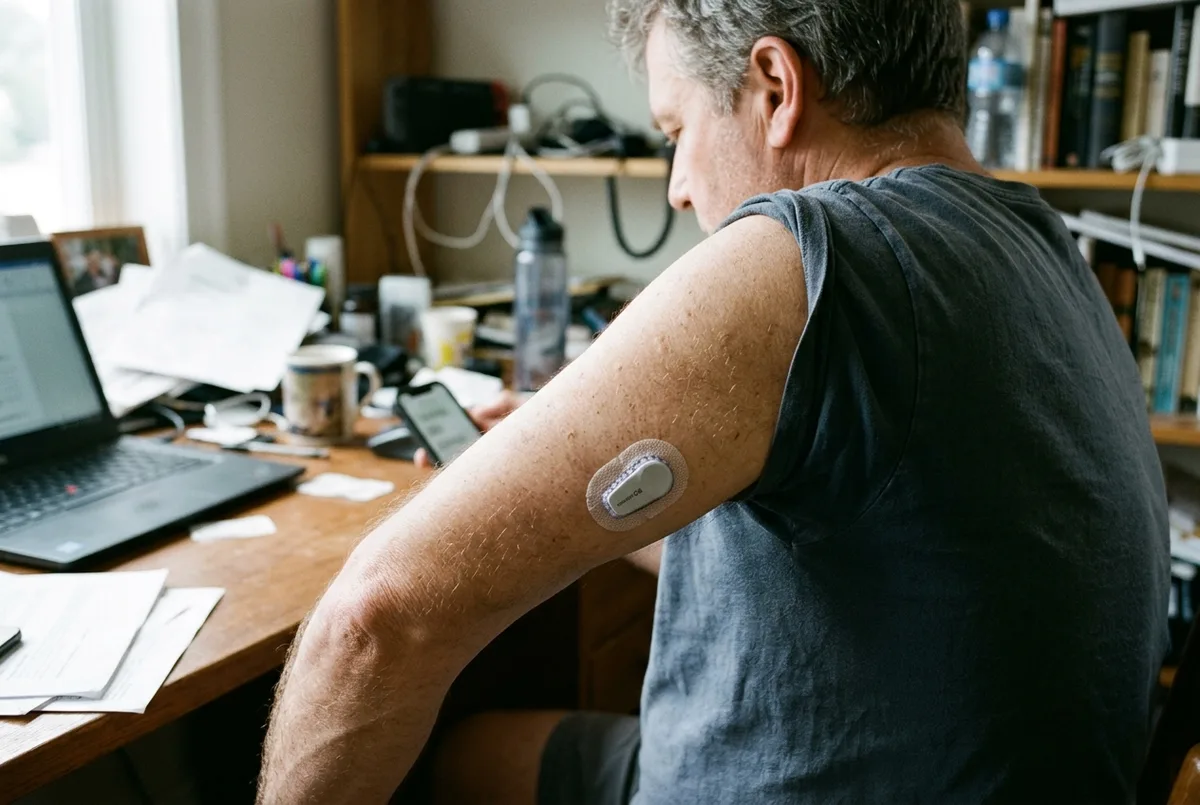
If you sleep on the side where your CGM sensor is, the pressure on the sensor can make it read falsely low. These are often called compression lows. They are not real low blood sugars.

In our patient's case, everything pointed to this:

  • His lows happened only during sleep
  • They fixed themselves without treatment
  • He takes no medicines that cause lows

But don't ignore a low alarm just because it might be fake. Always confirm with a finger stick. Treat it only if the finger stick shows it's truly low.

Know your diabetes medicines

Medicines that CAN cause low blood sugar:

Medicine typeExamples
Insulin (short- and long-acting)All types of insulin
SulfonylureasGlimepiride
MeglitinidesRepaglinide (pushes the pancreas to make more insulin)

Medicines that do NOT cause low blood sugar on their own:

Medicine typeExamples
BiguanidesMetformin
ThiazolidinedionesPioglitazone
SGLT2 inhibitorsJardiance, Farxiga
GLP-1 / GIP medicinesMounjaro

Note: The medicines in the second table can still contribute to lows if you take them together with insulin or a sulfonylurea. Ask your doctor about your combination.

Could it be something else?

Most low blood sugar in people with diabetes comes from medicines. But a good doctor keeps an open mind and rules out other causes. For our patient, we considered:

  1. Insulinoma, a tumor that makes too much insulin. It is very rare (about 1 in a million). He never had lows with physical activity, so it was unlikely.
  2. Liver problems, which can cause lows. He has none.
  3. Adrenal insufficiency, a hormone problem that can cause lows. He doesn't have it.

With these ruled out, the most likely explanation was a false low from sensor pressure.

Myths vs. facts

MythFact
"My CGM is always right."Pressure on the sensor during sleep can cause false lows.
"All diabetes pills cause low sugar."Metformin, Jardiance, Farxiga, and Mounjaro don't cause lows on their own.
"Glucose tablets fix everything."They work fast, but follow them with food to prevent another crash.
"A low alarm at night can be ignored."Always confirm with a finger stick first.

Quick recap

  1. Low sugar = below 70. Below 40 is an emergency.
  2. CGM says low? Confirm with a finger stick, especially at night.
  3. Treat only true lows, and follow fast sugar with real food.

Know someone who wears a CGM? Share this with them. It might save them a 3 a.m. glass of juice they never needed.

This article is for general education and is not a substitute for personal medical advice. Talk to your doctor about your own blood sugar and medicines.

Book an appointment

Choose a time online with Dr. Vijay Katari, MD at our Frisco or McKinney office, or call (214) 884-2774.

Medical disclaimer: This website is for general information only and is not medical advice, diagnosis or treatment. Always seek the advice of your physician with any questions about a medical condition. In an emergency, call 911.

Book a visit with Dr. Vijay Katari, MD

Where do you need care?

Before you book

healow will show you real openings at Frisco. Before you pick a time, please read all five points below.

Ticking this takes you straight down to your booking details. The five points below still apply to your visit.

Read more about insurance and billing

If you use insurance, we check it before your visit — that check is not a promise that your plan will pay. Your insurer decides what it covers when it processes the claim, under your plan's rules. We will tell you honestly what we can see from our side, but your plan documents govern.

You are responsible for what your plan says you owe or does not cover. That includes your deductible, co-pay and co-insurance, and any service your plan does not cover — for example a visit your HMO has not authorized, or a preventive visit booked sooner than your plan allows.

Paying for yourself? Payment is due at the time of the visit; the plan table below gives the Good Faith Estimate.

Give us your current insurance, and tell us if it changes or ends. If we do not have your insurance details, or your coverage changes or ends before the claim is paid and we are not told, the balance for that visit is yours to pay.

This applies wherever you are seen — at the clinic, and at your assisted or independent living community.

Not sure what your plan covers? Ask your insurer, or call us at (214) 884-2774 before you book. Nothing here takes away any protection your plan or the law gives you.

1. When we can see you depends on your plan

Which plan do you have?
Your planSame-day visit?What has to happen first
Medicare with a supplement Yes — within a few hours We verify your insurance first. You need both Part A and Part B — Part B is the part that covers a doctor's visit, so without it payment is due at the time of the visit, by cash or card.
Medicare Advantage with a PPO
WellMed, BCBS, Aetna, Anthem, Cigna HealthSprings, Humana and other Medicare Advantage plans
Yes — within a few hours, on working days We verify your insurance first. A Medicare Advantage HMO is the next two rows — what matters is whose name is on the card.
Medicare Advantage HMO, with Dr. Katari already named on your card
A commercial HMO follows the same rule
Yes — within a few hours We verify your insurance first. This applies as long as you have not been seeing another primary care physician and have not changed the name on your card.
Medicare Advantage HMO, without Dr. Katari on your card
A commercial HMO follows the same rule
Not same day One of three things has to happen first: your insurer approves the visit in advance, or you obtain a prior-authorization code from your insurer and give it to our staff, or you have Dr. Katari named as your primary care physician on the card. A name change takes effect on the first of a following month — see below.
Any private plan with a PPO
BCBS, Cigna, Aetna, Humana, UnitedHealthcare and other major carriers
Yes — within a few hours, on working days We verify your insurance first.
EPO or POS Not guaranteed These work like an HMO, not like a PPO. Call us and we will check where you stand before you drive over.
Self-pay Yes — within a few hours, on working days Nothing to verify. Payment is due at the time of the visit. As a Good Faith Estimate that is about $170 for a new patient and $120 for a follow-up — an estimate, not a fixed price; ask us for it in writing when you book. If you expect to need care regularly, ask about the Direct Primary Care membership — yearly plans with predictable pricing. Membership is not insurance.
Which plan do you have?
Your planSeen on the scheduled day?What has to happen first
Medicare with a supplement Yes — usually within one to two weeks We verify your insurance first. You need both Part A and Part B — Part B is the part that covers a doctor's visit, so without it payment is due at the time of the visit, by cash or card. If something cannot wait for the next scheduled visit, we can often arrange an urgent same-day tele-visit. For a true emergency — chest pain, trouble breathing, stroke symptoms, a bad fall — call 911 first.
Medicare Advantage with a PPO
WellMed, BCBS, Aetna, Anthem, Cigna HealthSprings, Humana and other Medicare Advantage plans
Yes — on the scheduled day We verify your insurance first. A Medicare Advantage HMO is the next two rows — what matters is whose name is on the card. An urgent tele-visit can be arranged sooner if it is needed.
Medicare Advantage HMO, with Dr. Katari already named on the card
A commercial HMO follows the same rule
Yes — on the scheduled day We verify your insurance first.
Medicare Advantage HMO, without Dr. Katari on the card
A commercial HMO follows the same rule
Not until it is authorized Your insurer approves the visit in advance, or a prior-authorization code is obtained, or Dr. Katari is named as the primary care physician on the card.
Any private plan with a PPO Yes — on the scheduled day We verify your insurance first.
Self-pay Yes — on the scheduled day Nothing to verify. Payment is due at the time of the visit. As a Good Faith Estimate that is about $170 for a new patient and $120 for a follow-up — an estimate, not a fixed price; ask us for it in writing. If the resident needs care regularly, ask about the Direct Primary Care membership. Membership is not insurance.

On an HMO and need to be seen sooner? Call us at (214) 884-2774. Insurers will sometimes issue a priority or prior-authorization number that lets us see you right away, and we will ask on your behalf. Your insurer gives us a reference number for it, which we have to have before your visit.

Getting Dr. Katari named on your HMO card. Ask your insurer to list him as your primary care physician. The change takes effect on the first of a following month rather than straight away, so allow one to two calendar months — and ask as early in the month as you can, because a request made late in the month usually will not take effect until the month after next. Once his name is on the card, you can be seen the same day like any other patient.

If this is an emergency — chest pain, trouble breathing, stroke symptoms, a serious injury — go to the nearest emergency room or call 911. Do not wait for an appointment.

2. A wellness visit is not a sick visit, and not a problem visit either

A wellness visit is a prevention-planning appointment: your history, your screenings, your medications and a plan for the year ahead. Two different kinds of appointment are not covered by it — a sick visit for something new like a cough, a cold or an infection, and a problem visit to manage an ongoing condition like diabetes or high blood pressure. Each needs its own time.

If you need both, say so when you book and we will schedule the time for it. They are separate services and may be billed separately.

If you are 65 or over, this is your Medicare Annual Wellness Visit.

If you are under 65, the equivalent is an annual physical or wellness visit through your commercial plan — a different service with different rules, set out in the next point.

On Medicare, the Annual Wellness Visit runs on a rolling clock — at least 11 full months after your last one — so it is not tied to a particular month. Commercial plans differ: some cover one preventive visit per calendar year, others require a full year between visits. We check your plan's rule when we verify your insurance.

Please book it as the right kind of visit. If you book for an acute problem, we can deal with the acute problem — but we cannot turn that appointment into your annual visit on the day. Booking the wrong one is the usual reason an insurer refuses to pay, so tell us which you need and we will put the right time aside.

3. Under 65? Your annual physical follows your commercial plan's rules

It is billed once a year, per patient — and only one doctor can bill it. If another provider has already billed a physical this cycle, your plan will not pay for a second one, however the appointment was labeled.

It must stay preventive. The visit is for someone without new symptoms: screenings, counseling and the year's prevention plan. Raise a new problem or need a new prescription during it, and that becomes an additional service on the day, billed separately under your plan's rules.

It runs on your plan's rules, not ours. What is included, what codes as preventive and what you pay for the extras is decided by your commercial plan — we will tell you honestly what we can see from our side, but the plan documents govern.

4. Your time is requested. The appointment is not confirmed yet.

Whichever time you pick, the appointment is not confirmed until two things are settled: your insurance is verified, and the slot is actually available. Our staff check both and call you back — usually the same business day. If either does not work out we will call you and move it, rather than let you find out at the front desk.

Please give us the phone number that is registered with us — and when you call, call from it. The practice receives a steady stream of junk calls, and the registered number is how our staff recognize you and know whom to call back.

Have your insurance card with you when you book. We need the plan name, member ID and group number to check what your visit is covered for before you are seen.

A credit card is kept on file to hold clinic appointments. You give it on the secure new-patient packet you sign electronically — never typed into this website, and never over email or text. It is charged only for balances you have authorised: the $100 no-show fee for an appointment missed without notice, and anything left after your insurance has processed the claim. Cancel or reschedule at least 24 hours ahead and no fee applies. An unfilled slot is a patient who could have been seen.

5. Follow-ups, refills and what counts as a separate visit

A wellness visit or annual physical covers preventive care only: screening and counseling aimed at preventing infection, heart disease, high blood pressure, diabetes and high cholesterol. Anything outside that is its own appointment.

A new problem or a new prescription is a separate visit. If you raise something new during a preventive visit, it becomes a second service on the day and your plan will usually charge for it separately — commonly in the region of $50 to $100, though what you actually pay depends on your plan.

Follow-up visits are for one or two problems. That is what the time is booked for, and trying to cover everything in one appointment is how visits end up rushed. If you have a longer list, tell us when you book and we will find the time for it.

Chronic medications are prescribed for 90 days. Book your follow-up every three months so a refill never runs out while you are waiting for an appointment. Going away for 91 days or more — a long trip, a season abroad? Book an appointment in the month before you leave, so your prescriptions cover the time you are gone.

Antibiotics usually need an exam or a rapid test first — prescribing without one is how the wrong drug gets given. For established patients whose condition we already know well — for example those in our chronic care and remote monitoring program — some decisions can safely be made by phone or tele-visit between appointments. Dr. Katari decides case by case; new infections usually still need to be seen.

Controlled substances are case by case and are never guaranteed. Depending on what you need, the right person to manage it may be a pain specialist or a psychiatrist, and we will tell you honestly if that is so.

Before we can visit a resident

The new patient packet has to be signed. Every new patient signs it, and it goes out electronically through DocuSign — we will send the link when you get in touch. It covers consent along with the financial power of attorney and medical power of attorney details we need on file. An out-of-hospital DNR is a separate document; tell us if one is in place. Please do not send any of these through this website.

We come on your community's scheduled day. Dr. Katari visits each community on a set day, generally once every two weeks, rather than on request. If something cannot wait for the next scheduled visit, call us at (214) 884-2774 — for many residents we can arrange an urgent tele-visit the same day. For a true emergency, call 911 first.

Please keep a four-hour window for the visit. Dr. Katari sees residents at several communities on the same day, so we give a window rather than a fixed time — this applies to assisted and independent living alike. Coming to you saves the resident the drive, the waiting room and a second person's time, and in return we ask for that flexibility. Because we come on the scheduled day, the $100 no-show fee for missed clinic appointments does not apply to visits at your community; it does apply to a clinic appointment, including one made for an independent-living resident.

Every November we check your insurance again. Plans change at the turn of the year, and a plan that changes without us knowing is how a visit stops being covered. We email every resident and family each November to confirm what is current — please reply to it even if nothing has changed.

We strongly recommend chronic care and remote monitoring for every resident. Chronic care is the phone contact between visits, where medication for something like high blood pressure or diabetes is reviewed and adjusted without waiting for the next round. Remote monitoring is the equipment that tracks blood pressure and blood sugar, so we see the readings as they happen. In Medicare's own evaluations of chronic care management, enrolled patients ended up in hospital less often; families get an update every month, and regular reviews often simplify the medication list. Individual results vary.

Where can we reach you?

Our staff confirm every booking by phone, and the new-patient forms are signed electronically through DocuSign — we need both to hold your time.

Are you on Medicare or a Medicare Advantage plan?

This decides which new-patient packet we send you. The Medicare packet includes the care-management consents, which apply only to Medicare plans — and which you are free to leave unsigned.

Please give the phone number that is registered with us. The email is where the DocuSign forms go — nothing about your health is sent to it.

Tell us where to come

Residents, family members and community staff can all send this. Give us the community and a phone number and we will call to arrange the visit and sort out the insurance side before Dr. Katari comes out.

Contact details only, please — no dates of birth, plan numbers, symptoms or diagnoses. We will collect what we need on the phone.

Include an email and we will send the DocuSign new-patient forms to it straight away — they must be signed before the first visit.

Just so we know whether to send you the DocuSign form. Do not attach or type any of the documents here.

Type your name and the date to confirm you have read the five points above and the practice's policies and procedures, which are updated periodically. We cannot book an appointment without it.

Signature (optional)

If you like, add a drawn signature with your finger or your mouse — your typed name above is enough on its own.

We keep a copy of what you have read, together with your name, the date and any signature you draw, and the practice can view it. Please do not enter anything about your health here. The consent and new-patient forms are signed separately through DocuSign.

Book Appointment at Clinic Or call (214) 884-2774

Tick the box above to continue.

Type at least two letters to search.